


Plaster, Earth Pigments and Bitumen: How We Bring Our Tavern to Life
A wooden object can be perfectly built, sanded and assembled, but it is during the finishing process that it truly begins to develop its own character.
In our workshop, this stage is not simply about applying an even coat of colour. For our Tavern screen, Mitsuki works across the surface using a succession of plaster, pigments, glazes and bitumen, creating variations, shadows and subtle marks that add depth to the entire structure.
The goal is not to make the wood look neglected or artificially damaged. Instead, we want to suggest a story: that of an object that might have spent years resting on the counter of an old tavern, surrounded by fireplace smoke, road dust and the traces left behind by travellers and adventurers.
Plaster Is Not Only Used for Filling
Plaster is normally used to fill small imperfections, joints and cavities. In our process, however, it also becomes a genuine decorative material.
Mitsuki applies it selectively across the surface, allowing it to build up more heavily in the areas where we want to create greater texture and depth.
Colouring the Plaster with Earth Pigments and Oxides
To prevent the plaster from looking too white, clean or modern, we colour it directly using powdered pigments.
For the Tavern, we mainly use:
iron oxide;
carbon black;
English red.
These pigments can be mixed in different proportions to create shades ranging from warm, earthy browns to burnt reds and very dark greys.

Iron oxide allows us to build a natural base close to the colours of soil, rust and worn materials. Carbon black is used to mute and deepen the mixture, creating stronger shadows and darker deposits. English red adds a warm, slightly reddish component that prevents the result from becoming excessively grey or uniform.
We do not use these colours as if they were an opaque coat of paint. Instead, we mix them directly into the plaster so that the colour becomes part of the material itself.
This means that even when the plaster is sanded, scratched or partially removed, it retains a tone that remains consistent with the rest of the screen and continues its visual narrative.
The Value of Small Irregularities
During this stage, we are not trying to create a perfectly uniform surface.
The slight variations in colour, the small accumulations of material and the marks left by removing the plaster are precisely what make the Tavern feel textured and alive.
The manual process allows Mitsuki to constantly observe the result and decide where further work is needed.
It is a process guided by the eye and by experience, rather than by a completely fixed formula.
What Is Judaean Bitumen?
After the plaster has been worked, we move on to Judaean bitumen, also known as Bitumen of Judea.
It is a traditional product used in restoration, decoration and patination techniques to create dark glazes and reproduce the visual effects of age.
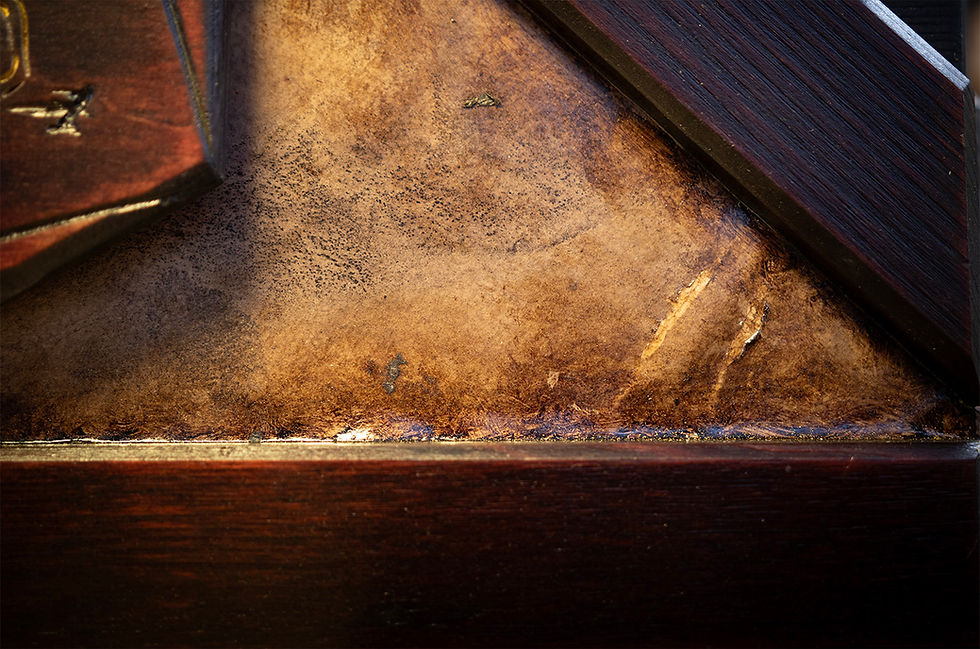
Its colour is a very deep brown, almost black where it becomes more concentrated. When applied in small amounts and then worked or partially removed, the bitumen remains mainly inside cavities and corners.
This makes it especially useful for bringing out details.
Only a thin glaze remains on the more exposed areas, while the bitumen gathers in deeper sections and creates stronger shadows.
Bitumen as a Storytelling Tool
On the Tavern, bitumen is not used to darken the entire screen indiscriminately.
Mitsuki applies and works it while continuously evaluating the shape of the object. It is left inside joints, around decorative elements, along certain edges and in the areas where dirt and the passing of time would naturally leave their traces.
The final result suggests a lived-in surface without making the object appear excessively dark or dirty.
On the lighter areas, the bitumen creates a warm glaze that helps connect the different tones.
It is a delicate stage, because too much bitumen could cover the previous work. For this reason, it is applied gradually, adding depth where needed and removing it where the surface needs to breathe again.
Building the Passage of Time, Layer by Layer
The character of the Tavern does not come from a single colour or technique.
It emerges through the layering of many different elements: the wood, the colouring of the plasterwork, the pigmented plaster, earth pigments, oxides, shadows and, finally, the bitumen glazes.
Each layer changes the one beneath it while still allowing part of it to remain visible. It is this stratification that creates a surface that feels both complex and believable.
From a distance, the Tavern appears as a single, coherent object. Seen up close, however, small differences begin to emerge: a darker engraving, a reddish trace, a worn edge or an area where pigment appears to have settled over the years.
These are subtle details, but they help transform a Game Master screen into a scenic element capable of becoming part of the atmosphere of the session.


Comments